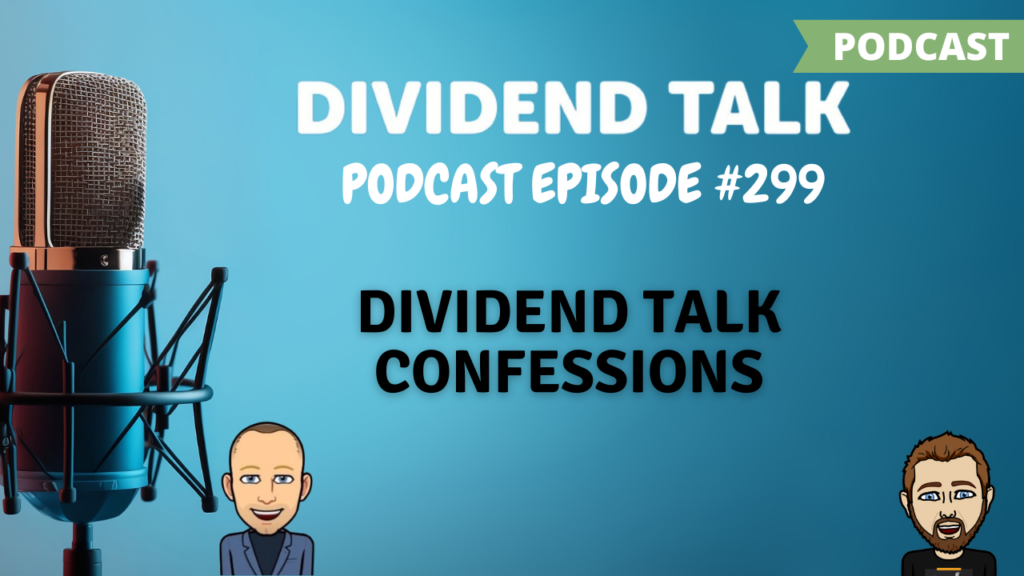
There’s a version of this podcast where Derek and EDGI only talk about their winners. Where every stock was bought at the right price, held with conviction, and rewarded with decades of growing income. That show doesn’t exist. Episode 299 is the other one.
Titled “Dividend Talk Confessions,” this episode — recorded the week before the landmark Episode 300 live show — is exactly what it sounds like. Both hosts opened the vault on the stocks they’d rather forget: the high yield traps, the dividend cuts they didn’t see coming, the companies they held too long, sold too early, and the calls they got completely wrong. What comes out is one of the most honest and useful conversations in the podcast’s run, because the mistakes Derek and EDGI made are the same ones every dividend growth investor makes at some point.
Before diving into the confessions, the episode opened with a sharp read on current market conditions. The SpaceX IPO — rumoured at a $1.7–1.8 trillion valuation — is generating the kind of hype EDGI described as “euphoria on the market cycle poster.” Alphabet (GOOGL) and Meta Platforms (META) both issuing new shares to fund AI infrastructure struck both hosts as a strange sign of the times. As EDGI put it bluntly: two of the most cash-rich companies on earth, diluting shareholders to fund AI spending. There was also discussion of the US jobs report and the paradox it creates — a strong economy pushes interest rate expectations up, which hammers rate-sensitive names. “If you just buy companies with little debt and high margins,” EDGI said, “they don’t really care about interest rates.”
Dividend Hike News: UnitedHealth (UNH) and Medtronic (MDT)
Two dividend announcements led the week. UnitedHealth Group (UNH) raised its dividend 5% to $3.32 per share — a sign the company is recovering its footing after a turbulent stretch. Medtronic (MDT) raised its dividend just 1.4%, to $0.72 per share. That modest figure prompted a proper deep dive, triggered by listener Brett’s question on the company.
EDGI’s verdict was blunt. Medtronic has made roughly $4.8 billion in net income this year — barely above the $4.6 billion it earned in 2019. Nearly six years of flat earnings. The company’s major acquisition a few years back, which was supposed to deliver synergies, came out net neutral on earnings per share and free cash flow. Meanwhile, a rising payout ratio and a share price near a ten-year low tell the rest of the story. At around $81 with a 22x earnings multiple, neither host could justify the valuation for a business with no visible growth.
“Why does a no-growth company that hikes the dividend 1.4% need to trade at a 22 multiple?” EDGI asked. “It should be trading at eight, nine, or ten.” Derek added that if Medtronic (MDT) traded closer to a 10–11x PE, the yield would approach 7% and the stock would at least be interesting as what EDGI called a “cigar butt” — take the cash, reinvest it elsewhere, and don’t expect growth from the source. For now, both have sold or avoided it.
The Confessions: Dumbest Stocks, Worst Calls, and One Crypto Secret
EDGI’s self-described “dumbest purchase by a mile” was Tupperware Brands — a company that filed for Chapter 11 bankruptcy in September 2024. The story starts with a CEO on CNBC pitching the untapped potential of empowering Indonesian women to become Tupperware entrepreneurs. “I really thought — Indonesia, economic growth, women emancipating, let’s do it,” EDGI laughed. He bought it partly for the near-5% yield. None of the growth thesis materialised, and the brand — already fading in European households — eventually collapsed under declining sales and mounting debt. The current share price: two cents.
For Derek, the clearest example of a high yield trap was Walgreens Boots Alliance (WBA). At the time it was a Dividend Aristocrat, had a compelling story around VillageMD healthcare clinics, and Walgreens locations appeared to be on every street corner in American cities. Every metric was declining, Derek acknowledged — and he saw it — but he justified it anyway. “You read all the books, you preach strong balance sheets and growing revenue, and then you do the exact opposite at the same time.” The dividend was cut once, then again, and the company is a shadow of what it was. Derek also mentioned Canopy Growth (CGC) — a cannabis play from 2016 he thought would be the next big thing — and AT&T (T), a classic dividend trap that still catches new investors today. He also held Medical Properties Trust (MPW) briefly before the company ran into serious trouble, though he got in and out without major damage.
Among the stocks both got dead wrong: Intel (INTC). EDGI had a thesis built around Intel’s purchase of ASML’s cutting-edge lithography machines and its eventual comeback in semiconductor manufacturing. He exited after watching market share evaporate and free cash flow deteriorate through Pat Gelsinger’s tenure. He later used the position for tax harvesting. Intel has since recovered significantly, and EDGI acknowledged his thesis was directionally correct — just too early, and the disruption in data centres was worse than expected. Derek also held Intel, buying around $30 and selling around $50 repeatedly, but exited before the dividend cut when Gelsinger’s execution started to unravel. VF Corp (VFC) and WP Carey (WPC) also came up — Derek had flagged a “questionable” dividend rating on WPC in his own newsletter and bought anyway. Two weeks later, WPC cut its payout. Lesson taken.
For stocks sold too early, EDGI’s clearest regret was General Electric (GE). He sold at the bottom after years of watching it decline under Jeff Immelt, only to see the stock go three to five times higher as GE was broken up and restructured. Derek’s equivalents were Microsoft (MSFT) — bought at $120, sold at $140–150, now above $400 — and ADP, bought at $80, sold at $100, never seen back. Price anchoring came up here too: EDGI noted that where you first bought a stock permanently shapes how you see its current value. He and Derek both own Ahold Delhaize (AD.AS) at cost bases around €19–23, which makes the current €30+ price feel expensive even though it isn’t.
The guilty pleasure segment produced the episode’s most surprising moment: Derek admitted to holding roughly €5,000 in cryptocurrency — specifically Solana (SOL-USD) and Fetch.ai (FET-USD) — something he had never mentioned on air. He also shared the backstory: he once owned a full Bitcoin, accumulated over a year at around $4,000 each. He sold it to buy a project called Spectre that paid a weekly “dividend.” The price of Spectre fell to the floor. Bitcoin went to $60,000–70,000. “That’s actually my dumbest decision,” he admitted. EDGI’s response: “You cheated on the community.”
Listener Q&A: Portfolio Sizing, Consumer Staples, and World Cup Stocks
The Q&A section covered several strong questions. On EDGI’s tier system (a recurring listener request): Tier 1 positions target roughly 4% of portfolio dividend income, Tier 2 at 3%, Tier 3 at 2%, and Tier 4 at 1%. Microsoft (MSFT) and Johnson & Johnson (JNJ) sit at the top. General Mills (GIS) would be more typical of a Tier 4 name. Wolters Kluwer (WKL.AS) and ADP (ADP) sit comfortably at Tier 2. EDGI has reserved a Tier 2 spot for Snap-on (SNA) and Iberdola (IBE.MC) when valuations come in.
On consumer staples accounting, Derek flagged three things he looks for first: gross margin trends (pricing power), inventory turnover (you don’t want product sitting on shelves), and goodwill/intangibles (critical for brand-heavy names like Coca-Cola (KO)). EDGI added that unlike REITs — where you need to dig into funds from operations — or oil and gas, consumer staples are about the most straightforward businesses to analyse using standard metrics.
On CAGR targets: EDGI uses the Chowder Rule (dividend yield plus five-year CAGR) as a rough framework, targeting around 11–12% combined at the portfolio level. If a stock yields 3%, he wants 7–9% dividend growth. Derek is slightly more lenient — around 5–6% growth for a 3% yielder — but the logic is similar. Both stressed that once a stock is in the portfolio, total return starts to matter more than whether it’s still hitting the original entry criteria.
On World Cup stocks, Nike (NKE) was the clear answer. The new CEO has correctly diagnosed where the brand lost its way, and the World Cup gives Nike maximum product visibility. Derek floated Coca-Cola (KO) as a potential sales beneficiary over the tournament window. On high yield reinvestment, EDGI walked through his Omega Healthcare (OHI) position — a stock he’s held for years at 8–10% yield on cost — noting that while OHI hasn’t raised its dividend in years, reinvesting the income into other names compounds the total dividend income meaningfully over time. Shell (SHEL) was mentioned as another name where he uses the same approach.
On Berkshire Hathaway (BRK.B): the acquisition of Taylor Morrison Home Corp (TMHC) at a 24% premium looked like a textbook Berkshire deal — a well-run national homebuilder at a reasonable price. The $10 billion investment in Alphabet (GOOGL) AI infrastructure was more interesting to both hosts as a signal. “Greg understands tech better,” EDGI said of Greg Abel. Derek agreed — it suggests Berkshire’s capital allocation under Abel will be somewhat more comfortable with big tech than the Buffett era was.
Finally, Munich Re (MUV2.DE) came up following a sharp recent dip. EDGI pointed to weaker policy renewal data in the latest quarterly earnings — a possible mean reversion after an exceptional run driven by post-California-wildfire insurance pricing. He noted he is currently in the middle of a deep dive on Munich Re and would publish a full analysis the following day.
What Both Hosts Changed Their Minds On
EDGI’s evolved view: he used to believe governments were effective capital allocators — that taxes funding redistribution was the right model. He no longer believes that. The EU’s plan to spend €200 billion on AI and data centres struck him as an example of the problem: the money will likely flow to large European companies that don’t need it, rather than create the ecosystem conditions that would attract genuine startup investment. His prescription: less regulation, economic free zones, and a hands-off approach to allow private capital to do what public capital can’t.
Derek’s: the classic “buy and hold forever” philosophy. In a world where technology shifts, macroeconomic cycles, management teams change and companies restructure, he doesn’t believe permanent conviction in any single stock is healthy. His revised view is “buy, reassess, and stay on top of the portfolio.” His Intel and WP Carey experiences reinforced it.
Listen to the Full Episode
Episode 299 of the Dividend Talk Podcast is available on Spotify, Apple Podcasts, and YouTube. Episode 300 is a live show
Disclaimer:
Neither Derek nor EDGI is a financial advisor. Nothing in this article or the associated podcast episode constitutes financial or investment advice. All views expressed are personal opinions only. Always conduct your own research and consult a qualified financial professional before making any investment decisions.
🐦 Follow @DividendTalk and @EuropeanDGI on X/Twitter
🌐go Premium dividendtalk.eu